A Decision Most Businesses Get Wrong
When a business needs a new website, the conversation usually skips the most important question.
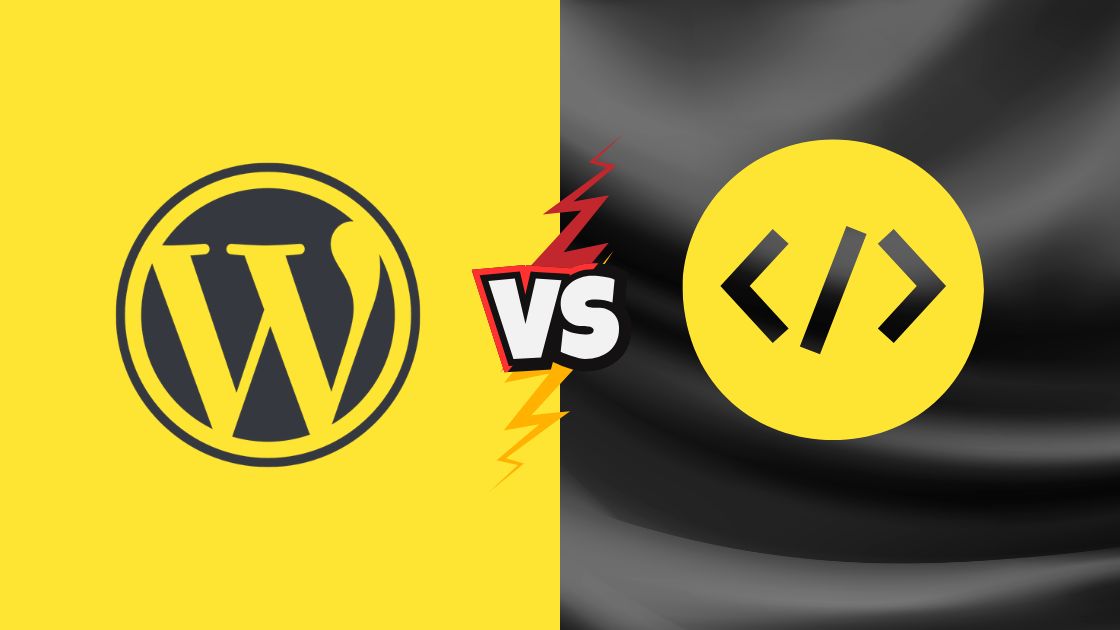
People ask, "Should we use WordPress or build custom?"
But that's the wrong way to frame it.
The right question is: what kind of operational relationship do we want with our website?
Because WordPress and custom code don't just produce different sites.
They produce different long-term responsibilities, costs, and growth ceilings.
What WordPress Actually Is
WordPress is a content management system with a 20-year-old plugin ecosystem.
It powers more than 40% of the web — from one-page brochures to The New York Times.
Its strength is content velocity:
- Non-developers can publish pages, blog posts, and updates
- A massive plugin library covers most common needs
- Themes provide a fast starting point
- Hosting is cheap and widely supported
Its weakness is structural drag:
- Plugins fight each other, slow down the site, and create security holes
- Theme code is often poor quality
- Performance requires real effort to maintain
- Customisation past a certain point becomes harder than starting fresh
WordPress is a city — well-mapped, mostly safe, but you accept the traffic.
What "Custom Code" Actually Means
A custom-coded site is built on a modern web framework — React, Next.js, Nuxt, Laravel, or similar.
Its strength is precision:
- Designed exactly around your workflow
- Faster, leaner, more secure by default
- No plugin economy means no plugin failures
- Scales gracefully as features grow
- Better SEO ceiling (Core Web Vitals, structured data, edge delivery)
Its weakness is dependency:
- You need a developer (or a team) to make most changes
- Initial cost is higher
- Content editing experience must be deliberately designed in (headless CMS, custom admin)
- Less ecosystem for casual plug-and-play features
Custom code is a tailored house — built for you, but you maintain it on your terms.
A Practical Framework
Forget the technology debate. Answer these five questions instead.
1. How often will non-developers edit the site?
- Daily / weekly → WordPress (or headless CMS with custom front-end)
- Monthly or less → Custom code is fine
2. How much of your business runs through the site?
- It's a brochure → WordPress
- It's a lead engine, store, or product → Custom code earns its keep
3. How important is performance to your business?
- Nice to have → WordPress with proper tuning
- Direct revenue impact (ecommerce, ads, conversions) → Custom code
4. How unique is your workflow?
- Standard pages, blog, contact form → WordPress
- Custom logic, integrations, dashboards → Custom code
5. What's your 3-year roadmap?
- Mostly content → WordPress
- Features, integrations, scale → Custom code
If three or more answers point one way, that's your platform.
The Middle Ground Most People Miss
You don't have to pick one.
A common modern setup:
- Custom-coded front-end (Next.js, Nuxt) for performance and design control
- Headless WordPress as the content editor your team already knows
You get content velocity and engineering quality.
It costs more to set up.
It saves more over five years.
The Hidden Cost of the Wrong Choice
Choosing the wrong platform doesn't show up in week one.
It shows up in year two, when:
- You can't add the feature your business now needs
- Your "fast" WordPress site is buried under 38 plugins
- Your "future-proof" custom site has no clear way to update content
- You're rebuilding from scratch with twice the data and twice the pressure
The right platform reduces friction every week for years.
The wrong one adds friction every week for years.
My Honest Recommendation
If you're a small business publishing content regularly, with a budget under $3K, WordPress is usually the right starting point — built properly, kept lean, maintained monthly.
If you're a growing business where the website is core infrastructure — ecommerce, SaaS, lead generation, product — custom code pays back faster than people expect, especially if you plan to operate it for 3+ years.
If you're somewhere in between, headless WordPress + a modern front-end is the underrated middle path.
Closing Thought
Technology choices are business choices in disguise.
The best platform isn't the trendiest or the cheapest.
It's the one that lets you operate your business with the least friction for the longest time.
If you're trying to decide, I'm happy to walk through the trade-offs with you.
Because the worst outcome isn't picking the "wrong" platform.
It's picking blindly.